MIASA/University of Ghana Interdisciplinary Fellow Group (IFG)

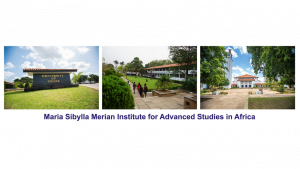
The Maria Sibylla Merian Institute for Advanced Studies in Africa (MIASA) is dedicated to research in the Humanities and Social Sciences. The overarching theme of MIASA is ‘sustainable governance’ from a genuine interdisciplinary and critical perspective, whereby ‘governance’ is understood in a wide sense, namely as the interplay of informal and formal rules for steering public affairs, embedded in historical, social, material and cultural practices of everyday life. Our main research axes are sustainable peace, sustainable democracy and sustainability transformation, but we are also interested in a wide range of intersectional sub-topics, such as landownership and acquisition, migration and mobility, restitution of colonially acquired cultural objects, African cities, human rights, and other related themes. MIASA is committed to reduce global asymmetries in knowledge production, to promote female scholarship and to bridge cultural divides. The institute offers time and space for supporting innovative academic research of top international quality. All MIASA fellowships are residential and mainly focus on onsite reflection, discussion and writing. In addition, MIASA facilitates networking and collaboration amongst leading researchers from Germany, Ghana, other parts of Africa and Europe and elsewhere in the world. The institute is located on the beautiful campus of the University of Ghana (UG) at Legon (Accra), and has been implemented in collaboration with the University of Freiburg, the Goethe University of Frankfurt, the German Institute for Global and Area Studies (GIGA) and the German Historical Institute Paris (GHIP). It is funded by the German Federal Ministry of Research, Technology and Space (BMFTR) with co-funding from the University of Ghana.
In this call for fellowships, MIASA welcomes applications from excellent researchers to join the interdisciplinary fellow group (IFG) “Sustainable Democracy” from 1 September to 31 December 2027.
Sustainable Democracy is one of MIASA’s three main thematic corridors. This research axis raises a wide range of questions that concern different forms of building and transforming institutions in past and present, not only on the level of the state and international organizations, but also of associations, grassroots movements, NGOs, religious organizations or “traditional” institutions, which all play a role in regulating social relations, in producing formal and practical norms, and in providing public goods. Democratic governance is entrenched in social, material and cultural practices of everyday life. The call invites applications that focus on one or several of the following questions:
- How do formal and informal institutions—including states, traditional authorities, religious organizations, civil society, grassroots movements and other community structures interact to—shape democratic governance, citizenship and everyday political life?
- How do different knowledge systems, languages, cultures and historical experiences influence democratic governance – what can we learn from a comparative perspective that values path-dependency?
- What are the decolonial and indigenous governance practices (already observed) and erspectives – for expansion along scales, anchorage in constitutions, (currently discussed) on sustainable democracy which could contribute to more inclusiveness and acceptance?
IFGs are MIASA’s central instrument for fostering original research on ‘Sustainable Governance’ and its connected thematic areas as mentioned above, which necessitates the input of experts from different academic fields and backgrounds. An IFG brings together a group of four fellows – ideally a mix of senior and junior fellows – for the duration of four months. Two of the fellows act as co-convenors. One of the two co-convenors is expected to be from the University of Ghana. IFGs are interdisciplinary and international.
The selection of fellows is made by MIASA’s distinguished international Academic Advisory Board. The all-important selection criteria are the academic excellence and originality of the application and the individual academic excellence of the applicant, the fit of each of the individual members into the overall composition of the group, guaranteeing the interdisciplinarity of the group, its international character, and its contribution to the academic environment at MIASA and the University of Ghana. Successful applicants becomeMIASA fellows with all the corresponding rights and obligations for the funding period (four months).
Fellowship conditions:
- MIASA covers the fellows’ salary costs or the costs for a teaching replacement and paid directly to his/her home institution according to the funders’ guidelines of minimum and maximum amounts for fellowship compensations.
- Fellows without employment receive a monthly grant.
- For all fellows from outside Accra, MIASA provides an accommodation allowance of up to 1500€/month and reimburses travel costs at the beginning and the end of the fellowship. For MIASA fellows who come with family members to Accra, MIASA can provide a family allowance.
- A small contribution to support research undertaken at MIASA can be granted to the MIASA fellow upon application to MIASA directors (up to 1000 € per fellow for the 4-month fellowship).
- Each co-convener receives a “convener-allowance” of 200 €/month.
- MIASA fellowships are managed by the University of Freiburg, who is the funding recipient of the German Federal Ministry for Research, Technology and Space (BMFTR) for MIASA’s fellowship programme.
Opportunities and expectations:
- Successful applicants become MIASA fellows with all the corresponding rights and obligations for the requested funding
- MIASA fellowships are residential fellowships and require being present at MIASA, University of Ghana, Legon campus. The maximum time of absence is 1/6 of the total duration of the fellowship, including archival or field research activities and conference participation, and needs prior approval by the directors.
- A contribution to the academic life at MIASA and the University of Ghana is expected (including participating actively at MIASA’s public lecture series as well as at the weekly internal seminar, which bring together all MIASA fellows).
- IFG co-conveners are responsible for developing the IFG research project based on the application and in close consultation with the MIASA team (the MIASA directors and the MIASA academic coordinator).
- The funding recipient, i.e. the University of Freiburg, is fully responsible for dealing with all administrative and financial matters related to the fellowships, research costs and IFG events. All financial and administrative matters have to be dealt with according to the BMFTR-DLR Merian Centres Information Guidelines and the regulations for expenditure of funds of the University of Freiburg.
- One public conference is organised by the IFG in collaboration with MIASA and a department/ centre/ institute of the University of Ghana. The selection of conference guests, programme and timing need the prior approval of MIASA directors. The budget for this conference is covered by MIASA via the funding recipient, i.e. the University of Freiburg. All expenditures for the conference must be made according to the regulations of the University of Freiburg, Germany.
- Each fellow is expected to submit a fellow report within 4 weeks after the end of the fellowship.
- The two co-convenors are, in addition, expected to submit a final IFG report summarizing the activities and main research findings of the IFG. This report will be published on MIASA’s academic blog.
- One or more individually or jointly written working papers, are expected to be published after the end of the IFG. Intellectual output of the IFG should also be reflected in reports or academic blog contributions. All presentations during the fellowship and all publications based on research conducted and results achieved during the fellowship must acknowledge MIASA and its sponsors, i.e. the German Federal Ministry for Research, Technology and Space as well as the University of Ghana.
Application dossier:
Please respect formal requirements:
- Formatting: font Arial, 11 pt, line spacing 1.5, all margins 2.5 cm.
- Page limits may not be exceeded.
Applications must include the following information:
- Front page with general information (2 pages):
- Title, name (last, first), e-mail address, link to webpage.
- Date of doctorate.
- Current position/affiliation, institution and business address (Name of institution/city/country).
- Research field.
- Project title.
- Abstract of the research project (max. 150 words).
- The two most important reasons why the research project matches the research focus of the IFG on “Sustainable Democracy”.
- Please indicate if you would like to act as one of the co-convenors of the group. (Selection will be done by the Academic Advisory Board)
- Project proposal (max. 5 pages):
- Project title (max. 50 characters)
- Abstract of the project (150 words)
- Aims, theoretical framework and methodology of the project.
- Work and time plan.
- Innovative potential, originality and relevance of the project and its contribution to the overall topic of Sustainable Democracy.
- Added value of conducting research at MIASA and the University of Ghana as well as of doing the research as a team.
- Bibliographical references (max. 1 page in addition to the 5 pages of the proposal).
- CV in tabular form (max. 2 pages).
- Publication list highlighting the most important publications (max. 2 pages).
Applications for the IFG on Sustainable Democracy for the period 1 September – 31 December 2027 have to be uploaded by 15 October 2026, 24:00 UTC to: https://mobility.frias.uni-freiburg.de/mobility/BewerbungServlet?identifier=FRIAS&kz_bew_pers=L&kz_bew_art=IN&aust_prog=MIASA_IFG&sprache=en
Successful candidates will be informed in March 2027.
For questions, please do not hesitate to contact miasa@act.uni-freiburg.de
Proviso: Fellowships are offered with the proviso that the Federal German Ministry of Research, Technology and Space (BMFTR) will grant continued funding for MIASA from September 2027 until February 2030.